






When claim volume grows but the auditing process stays manual, the revenue cycle can quickly become a barrier to growth. Line-by-line reviews consume valuable time, make it harder to apply payor rules consistently, and leave teams struggling to keep pace without adding staff.
Behavioral Innovations, an organization that has dedicated more than 25 years to quality ABA care, faced that challenge within its five-person auditing team. Reviewing and locking just one day of appointments could take four to five business days, creating an operational bottleneck that needed to be addressed.
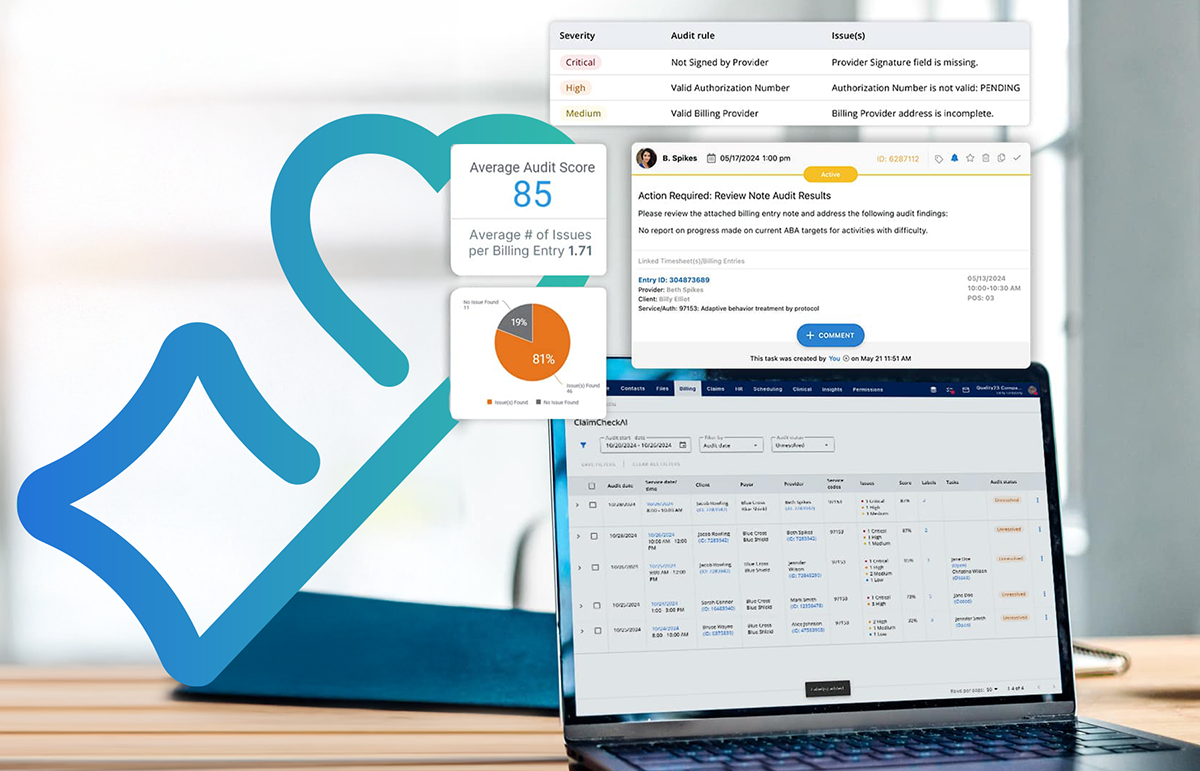
Automated claim review that flags exceptions before they become denials is what ClaimCheckAI delivers. As Bernestine Irvin, Vice President of Revenue Cycle Management at Behavioral Innovations, shared, it changed how the billing team worked. Instead of spending days reviewing claims line by line, team members could focus on resolving exceptions, addressing problems at their source, and keeping the revenue cycle moving.
For ABA organizations ready to make the same shift, Behavioral Innovations’ experience offers five practical lessons for moving from manual auditing to scalable automation.
1. Identify What’s Slowing the Process Down
Before automating a workflow, take time to understand where manual work is creating delays, inconsistencies, and risk. At Behavioral Innovations, auditors were responsible for reviewing every claim line for issues involving authorizations, diagnoses, modifiers, and payor-specific requirements. The work was repetitive, time-consuming, and dependent on team members knowing and consistently applying a large number of rules with a wide range of payors.
An in-depth understanding of the existing workflow helps pinpoint which repetitive tasks can be automated, which exceptions still require human judgment, and where better processes could prevent errors before claims are submitted. It also gives teams a clear baseline for measuring the impact of automation over time.
2. Start Small with a Payor You Know Well
Attempting to automate every payor and process at once can be overwhelming and introduce unnecessary risk. Instead, begin with a single payor whose requirements and denial patterns your team understands well.
Behavioral Innovations started with a controlled group of payors across different markets. The team researched each payor’s requirements, built payor-specific rules, analyzed the results, and made adjustments before expanding the rollout.
This focused approach gives teams an opportunity to validate their rules, resolve issues, address upstream problems, and build confidence in the process. Once the workflow produces reliable results, organizations can apply what they have learned and expand with more payors.
3. Build Trust Through the Data
Introducing automation can create uncertainty, especially among team members who worry about how their roles may change. At Behavioral Innovations, the priority was confidence in the accuracy of payor rules, and confidence that the transition wouldn’t create operational or financial disruption.
Starting small and letting the data lead helped to build confidence. Behavioral Innovations ran the manual and automated processes side by side, monitored the outputs, and shared the results with the team. This allowed employees and leaders to see that the process worked as intended before relying on it at scale.
When employees can see the results and understand how their expertise fits into the new workflow, skepticism can give way to trust.
4. Shift the Team’s Focus to Exceptions
Automation shouldn’t just speed up existing manual processes. It should also give the team more time to focus on work that requires human expertise.
At Behavioral Innovations, team members no longer had to review every claim line to find potential problems. Instead, they could focus on resolving the exceptions identified during the automated review process. They also gained more time to investigate recurring issues and address root causes of denials. This shift allows billing teams to move from reacting to problems after submission to preventing them upstream.
"We're being more proactive versus reactive, so we're collecting money faster, and it's allowing us to continue to improve the areas that will increase operations financially."
5. Measure Capacity, Not Just Time Saved
The value of RCM automation isn’t limited to how quickly claims move through the revenue cycle. It also lies in an organization’s ability to handle greater volume without increasing administrative burden.
Behavioral Innovations doubled its weekly claim volume from approximately 9,000 to 18,000 claims without hiring additional billing staff.
Measure success by looking at claim volume, automation rates, staffing needs, exception trends, and denial rates. Together, these metrics show whether automation is creating sustainable capacity for growth while maintaining accuracy and oversight.
Automation Supports a More Scalable Revenue Cycle
Behavioral Innovations’ experience illustrates how automation can transform claims auditing from a time-consuming manual process into a more proactive and scalable workflow. Making that shift requires a clear understanding of existing processes and a deliberate, well-validated rollout.
With automation, ABA organizations can create greater capacity without sacrificing accuracy or oversight. Start with a process your team understands, validate the results, build trust with data, and then expand with confidence.
Watch the full CR Unite 2026 session to hear how Behavioral Innovations transformed its billing operations and created greater capacity for growth.
Posted in Review
You may also like...
Related information and stories


5 Use Cases to Automate Clean Claims at Scale
Your manual claim processes don’t just slow cash flow. They create room for avoidable, costly errors. Manually generating claims, reviewing accuracy, making corrections, and submitting them to payors requires significant time and coordination. As a result,…

How Acorn Health Achieved 92% Same-Day Note Conversion by Fixing Documentation at the Source
Acorn Health, a multi-state ABA provider, needed a better way to manage documentation at scale. As session volume grew, manual review and retrospective auditing created delays in insight and limiting visibility into day-to-day performance. By shifting…