



Your manual claim processes don't just slow cash flow. They create room for avoidable, costly errors. Manually generating claims, reviewing accuracy, making corrections, and submitting them to payors requires significant time and coordination. As a result, claims often get stuck in a human worklist, delaying reimbursement and adding to administrative burden.
As organizations scale, manual billing workflows become harder to sustain. Each dependent step in the process adds friction and increases the likelihood of error.
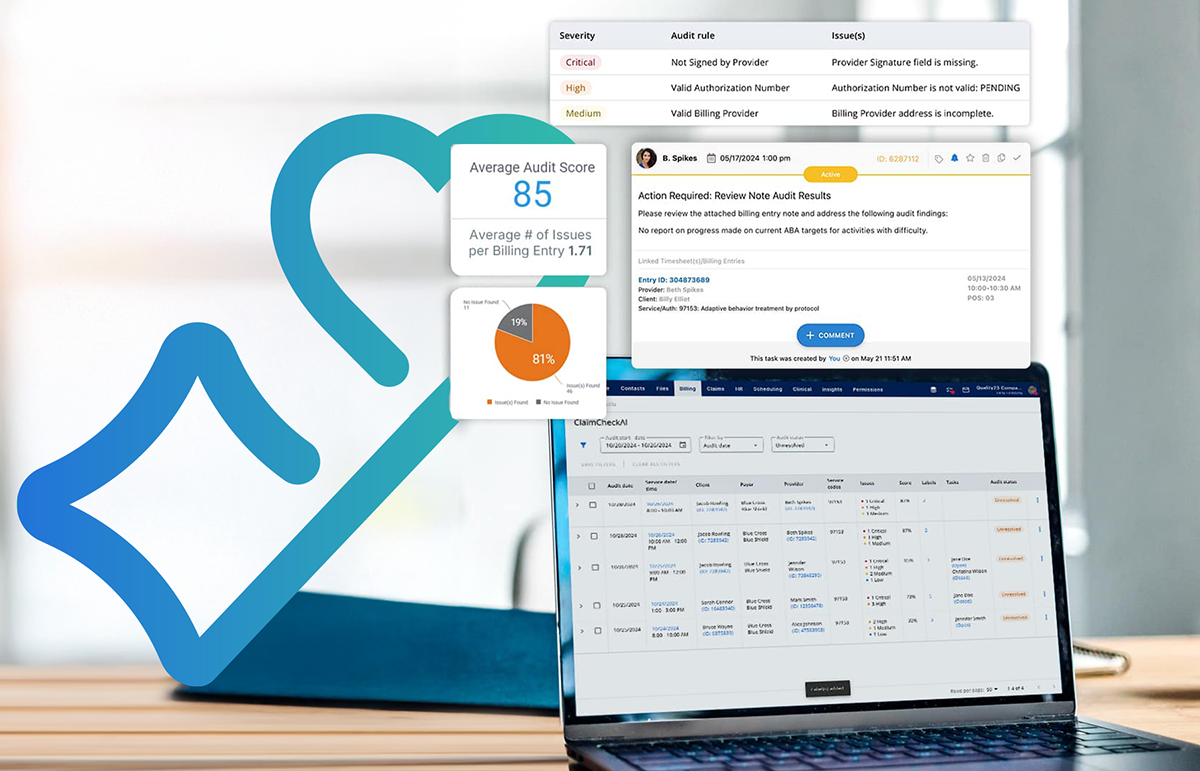
The key to clean claims at scale is automation. Modern billing workflows can continuously audit billing data against payor-specific rules, identify and resolve routine issues, generate compliant claims, and advance them through submission with minimal manual intervention.
Here are five high-impact ways billing teams can leverage automation to build a cleaner, more efficient claims pipeline.

The Shift Toward Automated Clean Claim Workflows
If you’re managing multiple payors, locations, or an overloaded billing team, manual workflows introduce variability at every step. Traditional billing processes rely on sequential human review, where validation, correction, claim creation, and submission each depend on the previous step.
But as an organization scales, these workflows break down. Errors are often identified late in the process, after claims have been submitted, resulting in delays, rework, and an increased likelihood of denials.
Modern billing systems are shifting toward an end-to-end workflow model that:
- Continuously validates billing data against payor rules
- Identifies and resolves routine issues before claim creation
- Routes only clean, compliant entries into claim generation
- Advances ready-to-bill entries through submission workflows
This shift fundamentally changes the role of billing teams. Instead of manually building and correcting individual claims, teams operate in exception-based workflows where routine validation is handled earlier in the process and staff focus only on complex situations. The result is a more consistent clean claims pipeline, fewer downstream denials, and faster movement from service delivery to reimbursement.
5 High-Impact Use Cases for Billing Teams
The Future of Clean Claims
Achieving clean claims at scale requires building accuracy directly into the billing workflow from the start. As organizations grow, the difference between teams that struggle with denials and those that maintain consistent reimbursement often comes down to how early issues are identified and resolved within the billing pipeline.
The shift toward automated billing workflows is making it possible to move beyond reactive billing altogether, reducing rework, improving predictability, and allowing clean claims to painlessly progress through the billing process.
You may also like...
Related information and stories

What is RCM?: How Therapy Practices Get Paid
Running a successful therapy practice requires a strong financial foundation. As Gosia Lindfeldt, Director of Business Operations and RCM of Beyond Autism Services, explains, “Any good ABA company can be…

Harness AI Technology for Efficient ABA Billing, Accurate Claims Auditing & Payor Compliance
See how ABA providers like PediaPlex are transforming billing with AI Navigating the complexities of billing as an ABA provider is no easy feat. Errors in CPT code usage, missing…

Innovative Applications of AI in ABA and Multidisciplinary Services
AI is revolutionizing the way services are delivered in Applied Behavior Analysis (ABA) and multidisciplinary care. From optimizing schedules to enhancing documentation, AI technologies are enhancing efficiency, effectiveness, and overall…