



At Abbie School, supporting learners with autism, ADHD, and other diverse learning needs means focusing on the whole child. The team believes student success comes from going beyond academics to also prioritize the social, emotional, and life skills students need to thrive in relationships, in school, and in everyday life. To make that happen, instruction is flexible and individualized, meeting each student where they are and helping them build momentum.
Delivering this level of specialized instruction requires clear, consistent insight into student progress. Abbie School needed tools that could streamline progress monitoring, simplify collaboration, and support stronger IEP development and implementation without adding operational burden for educators and support staff.
By moving away from paper data and other disjointed systems, Abbie School has created a more connected workflow for goal writing, data collection, assessment, and ongoing progress monitoring. This integration has reduced reliance on paper-based systems and improved efficiency. As Stacy Stewart, Director of Abbie School, shared, “Binders can get heavy, and they get filled, and then, you have all this paper, so it's been nice to have it in the digital form. Save some trees, and have it at your fingertips!”
Establishing a Strong Baseline with Early and Ongoing Assessment
Assessment results play a key role in guiding both IEP development and day-to-day instructional planning. Abbie School uses digital assessments to build a comprehensive understanding of each student’s unique strengths and needs while also monitoring progress over time.
To establish a clear baseline for measuring growth, the team assesses each student at the start of the school year. These early assessments not only provide foundational data for goal setting but also help identify any summer learning loss and inform initial goal priorities. In January, students are reassessed to evaluate progress and generate updated data that directly support IEP review, goal refinement, and instructional modifications.
One of the most important aspects of the assessment process is reporting and collaboration. Because assessment results are broken into detailed skill criteria, staff can more easily interpret student performance, identify skill gaps, and translate findings into actionable next steps. Results can also be shared across the broader IEP team, including with caregivers and other providers, enabling greater alignment. Built-in autoscoring and streamlined reporting also reduce administrative burden, allowing educators to spend less time on paperwork and more time on instruction.
“It's made writing goals for IEPs a whole lot easier, and it's meeting the students where they need to get the skills that they need to be more successful”
— Stacy Stewart, Director of Abbie School
Real-Time Data Collection for Improved Outcomes
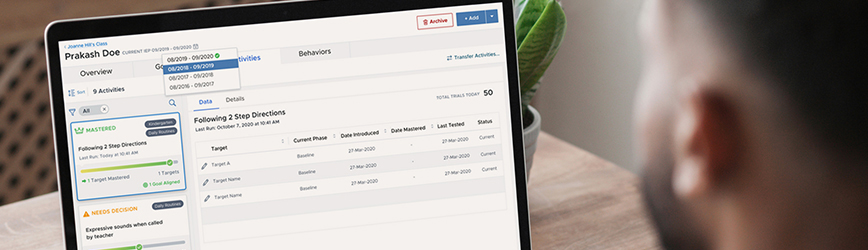
Abbie School uses an evidence-based digital platform as the backbone for daily data collection, progress monitoring, and collaboration across staff. By centralizing IEP goals, behavior tracking, and skill acquisition data, the school has created a more consistent and connected approach to decision-making.
With real-time data collection embedded throughout the day, educators can make more immediate, informed decisions and adjust instruction based on student performance. This ongoing visibility strengthens both academic and behavioral programming, ensuring interventions remain closely aligned with student needs and supporting greater fidelity between IEP goals and daily instruction.
A notable benefit for the team has been the ability to monitor multiple students simultaneously in an organized and accessible way.
“The greatest asset in using LiftEd has been the ability to keep data on multiple students at the same time. The data is organized and easy to see.”
— Molly, Teacher at Abbie School
Being daily data monitoring, instructional planning and staffing coordination have become more simplified. Teachers can seamlessly assign support roles and structure sessions.
“The fact that I, as a teacher, can easily assign my aides to certain students on certain days [with the Planner], and make that session go as long as I want has been very helpful.”
Measurable Impact: Efficiency, Clarity, and Student Momentum
With early and ongoing digital assessment and data tracking, Abbie School has strengthened the connection between assessment, IEP development, and daily instruction. Structured benchmarking enables staff to develop IEP goals that are both realistic and measurable, while ensuring those goals are carried directly into classroom instruction.
Abbie School’s integrated workflow has improved clarity around student progress, supported more consistent data-informed decision-making, and helped teams better understand where students are starting and how they’re progressing over time. As a result, staff can more effectively target individual student needs across domains and communicate progress to stakeholders.
Looking ahead, Abbie School plans to continue expanding its use of digital, data-driven instruction. With training already underway, they’ll be implementing personalized, student-centered tools to further support students in developing independence in social-emotional, executive functioning, and vocational skills, promoting whole-child learning.
Posted in Education, Special Education
You may also like...
Related information and stories

What Assessments Are Used to Diagnose Autism?
While there are distinct signs of autism, they can present differently with each individual. Therefore, professionals must conduct a comprehensive evaluation to diagnose autism spectrum disorder (ASD). During this evaluation,…

How Do Assessments Help in Developing Individualized Education Programs (IEPs)?
Crafting an Individualized Education Program (IEP) that incorporates learners’ unique strengths while addressing their challenges requires care and precision. Assessment for students with autism is critical in identifying students’ diverse…
Frontline and CR LiftEd – Integrating data collection and IEP management
A common challenge Special Education teachers, support professionals, and therapy service providers in schools face is disparate systems for daily data collection in classrooms , and compliance progress reporting for…