






For many ABA organizations, growth comes with a tradeoff. As they gain clients and open new locations, scheduling complexity also grows. To keep pace with increasing demands, expanding administrative teams often becomes necessary.
Gracent took a more proactive approach to growth. Already operating with strong scheduling processes and an organized team, the multi-site pediatric therapy provider wasn’t facing an immediate scheduling crisis. Instead, the team was thinking ahead. As the organization continued to grow, leadership recognized that manual scheduling would require more staff and administrative oversight.
To accommodate growth, Gracent invested in smarter scheduling workflows and automation. The result: a scalable operating model that supports expansion without added administrative burden. Today, three schedulers support 16 centers and more than 300 active clients.
• Provider coverage that once required manual coordination are now resolved in a single action
• Preferred provider pairings and block scheduling improved clinical consistency
• Schedule optimization supports seasonal changes, new center launches, and staffing transitions
• Cleaner operational data improved visibility across reporting and operational decision-making
The Challenge
As Gracent opened new centers, each expansion added layers of coordination, from last-minute coverage decisions to provider matching and ongoing schedule adjustments. Even with a well-run scheduling team, manual workflows naturally became more demanding as the practice scaled.
Provider coverage in particular was a challenge. As Jessica Thompson, Director of Scheduling, explained, “It was very manual—pulling up schedules, who's calling out, who's on the team, looking up different things.”
Leadership was already investing in AI across other areas of the organization and had begun evaluating options for automating scheduling. A primary consideration in that evaluation was integration. Adding tools outside of their clinical and practice management platform would have created disconnected data and duplicate work.
As Jessica Thompson, Director of Scheduling, explained, the team ultimately reached a clear inflection point in how they thought about scale: “We knew that we were either going to grow our team physically or we were going to invest in a tool that could help us scale.” —Jessica Thompson, Director of Scheduling, Gracent

The Shift
For Gracent, the goal was to ensure clients consistently received the clinically recommended number of hours while reducing the manual coordination required to maintain schedules across a growing company. The team implemented AI-powered scheduling to strengthen their existing foundation, allowing them to better support both scale and clinical consistency across centers.
As a result, scheduling shifted away from manual, session-by-session coordination toward a more streamlined model for managing cancellations and provider matching across multiple centers. From an operational standpoint, a key part of this shift was reducing fragmentation and keeping scheduling work within a single system.
"It helps overall with visibility, but also with allowing us to keep things in one place. It's hard when you have multiple systems, and you have to transfer data.”
— Marissa Rucker, Policy and Compliance Specialist, Gracent
The Operational Impact
With a centralized and automated scheduling model in place, Gracent was able to support continued expansion without increasing administrative headcount. As new centers opened, scheduling scaled alongside the organization rather than becoming a limiting factor.
Now, just three schedulers support more than 300 clients across 16 centers, maintaining consistent coverage across a rapidly growing practice.
Automation has reduced the manual burden of day-to-day coordination. Planned absences are now proactively covered, provider coverage efforts across multiple schedules are resolved in a single action. These improvements reduced reactive scheduling work and strengthened consistency in provider assignments and block scheduling across centers.
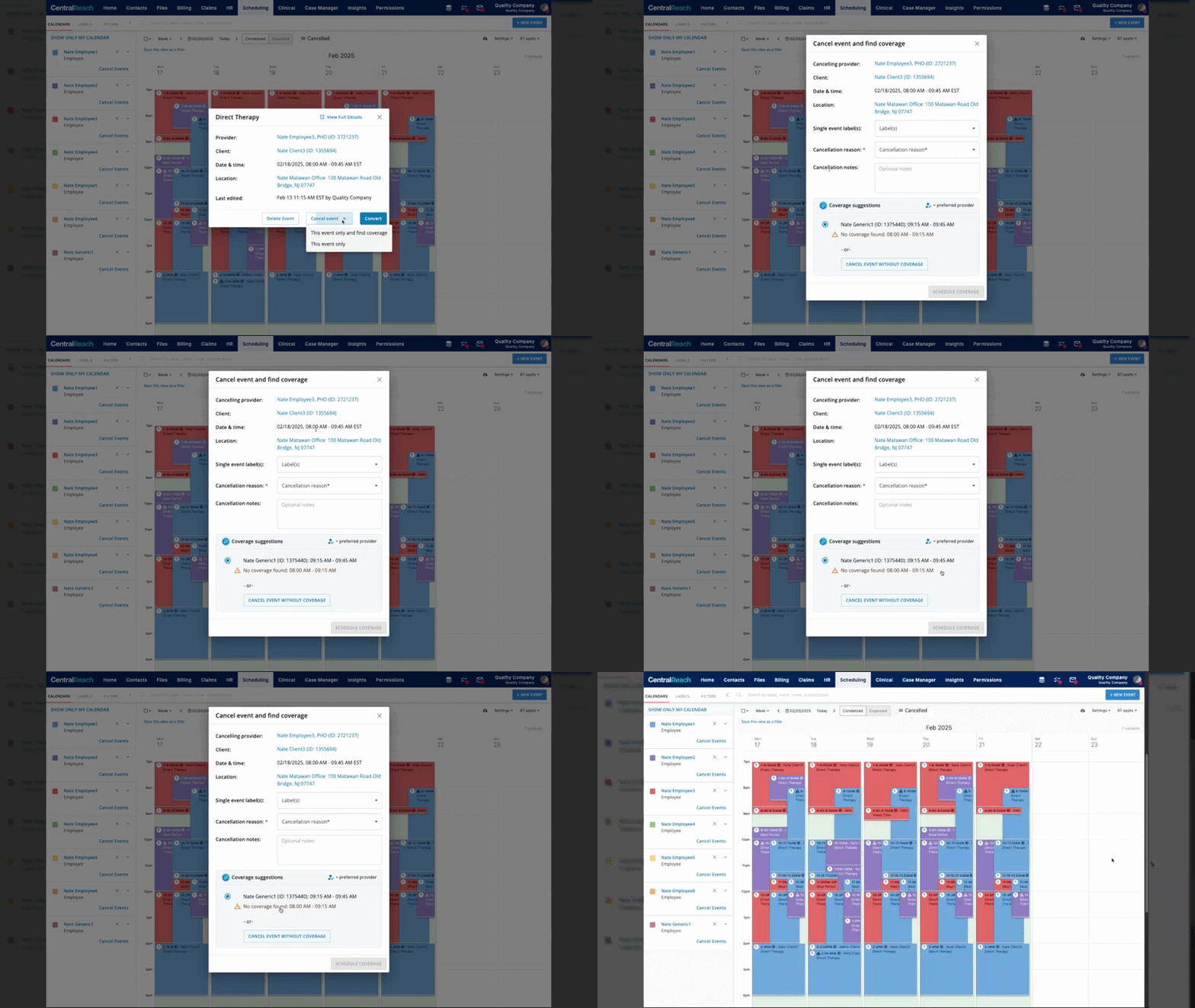
AI-Powered Scheduling: Built for Scalable Growth
Gracent’s approach to scheduling reflects a broader commitment to future-proofing. In a fast-evolving field, organizations need systems that can scale with them. By strengthening its existing scheduling foundation with AI-powered capabilities inside its practice management platform, Gracent reduced manual coordination and improved efficiency, and removed the need for additional administrative headcount.
Demand for ABA and other pediatric therapies isn’t slowing down, and neither is Gracent. Most importantly, the strong operational foundation they’ve built ensures they can continue to deliver high-quality care while supporting growth. Rather than becoming a barrier to expansion, scheduling has become a strategic advantage.

See AI-Powered Scheduling in Action
ABA and multidisciplinary practices are reducing administrative burden and scaling operations with intelligent scheduling built directly into CentralReach. With ScheduleAI, organizations can build optimized schedules in minutes, balancing availability, credentials, and client needs.
Posted in Clinical, Customer Story

You may also like...
Related information and stories

Enhance ABA Practices with Proactive Authorization Management
Effectively managing insurance authorizations while navigating the intricacies of delivering high-quality care is a shared challenge in the ABA field. Underutilized authorizations pose a significant risk, impacting client outcomes and…

Stop the Scheduling Spiral: An AI Fix for ABA Burnout
Scheduling-It’s the task that never ends for ABA practices. Between juggling staff and client availability, client needs and preferences, and the daily influx of changes, maintaining consistent schedules can feel…

Optimize Your ABA Operations with AI-Powered ABA Scheduling and IDD Software
Powered by cari, CentralReach’s proprietary AI agent, CR ScheduleAI analyzes hundreds of data points to match the right provider with the right client and fully optimize ABA and multidisciplinary schedules.…